In short
Managing emotions in trading means stopping fear, hope, frustration or euphoria from making the decisions your plan should make. It does not mean feeling nothing. Research on traders shows that intense reactions to both gains and losses go with worse results, and that acting before the emotion works better than hiding it. Your emotions leave measurable traces in your trade history.
Key takeaways
- Managing emotions in trading does not mean removing them: the goal is that they stop making your entry, sizing and exit decisions.
- In Lo, Repin and Steenbarger's 2005 study of 80 day traders, those who reacted most intensely to both gains and losses had significantly worse results.
- Among traders at City of London banks, Fenton-O'Creevy and colleagues (2011) found a performance advantage for those who regulate emotion upfront rather than suppressing it in the moment.
- Four emotional fingerprints can be measured in an MT4 or MT5 export: losers held longer than winners, a shorter gap and bigger size after a loss, and bigger size after a winning streak.
- In the illustrative example, 30 trades opened less than 15 minutes after a loss cost 7.5R, or €750 on a €10,000 account risking 1% per trade.
- The most effective rules are set before the session, in the form “if this situation happens, then I do this”.
You know the scene. Your plan is clear, your rules are written down, and still you move your stop “just a little”, you bail out of a winner at the first pullback, or you jump back in two minutes after a loss with a bigger size. You know what to do. You don’t do it. That gap is what managing emotions in trading is really about.
The usual guides tell you to “stay disciplined” and meditate. This article takes another route: what research has measured in real traders, how to find your emotional decisions in your MT4 or MT5 history, what they cost in R, and the rules that decide for you.
What does managing emotions in trading mean?
Managing emotions in trading is the set of methods that stop your emotional states from making the decisions your plan was supposed to make: entering, sizing, exiting. It is not about becoming numb. Fear, frustration, hope and euphoria will keep showing up. The goal is that they no longer control the mouse.
Three moments matter:
- Before the session: prepare for the situations that throw you off and decide your response with a cool head.
- During the trade: let orders placed at entry do the work, instead of deciding under pressure.
- After the session: measure in your history where emotion still made the call.
What does research say about traders’ emotions?
Research shows two things: intense emotional reactions go with worse results, and how you handle emotion matters as much as the emotion itself.
Intensity costs, in both directions. Andrew Lo, Dmitry Repin and Brett Steenbarger followed 80 day traders for five weeks, comparing a daily emotional-state survey with their daily results (American Economic Review, 2005). Those whose reaction to gains and losses was most intense, on the positive side as well as the negative side, performed significantly worse. Personality tests showed no specific “trader profile”: the skill seems to be learnable.
Acting early beats suppressing. Mark Fenton-O’Creevy and his coauthors interviewed traders at four investment banks in the City of London (Journal of Organizational Behavior, 2011). Traders who regulated emotion upfront had a performance advantage over those who mainly suppressed it in the moment. The authors describe a performance penalty for suppression.
Why suppression fails. Psychologist James Gross showed the mechanism in 1998: 120 participants watched a disgusting film, told either to reinterpret it so they would feel nothing or to hide their reactions. Both groups showed less emotion outwardly. But reinterpretation lowered the emotion they felt, while suppression increased physiological arousal.
Gritting your teeth in front of the screen does not make the emotion go away. It stays there, waiting for your next click.
Which emotions cost the most in trading?
The emotions that cost the most are the ones that change your size or your exit, because they distort your reward-to-risk ratio. Each one leaves a different fingerprint in your history.
| Emotion | What you do | Fingerprint in your history |
|---|---|---|
| Frustration after a loss | You jump back in, often bigger | Short gap and higher volume after a loss |
| Hope on a loser | You let it run, you move the stop | Losers held longer than winners |
| Fear of giving back a gain | You exit at the first pullback | Very short winners, average gain below planned risk |
| Euphoria after a winning streak | You size up, you lower your standards | Higher volume after gains |
| Fear of missing a move | You enter late | Entries far from the planned level, wider stop |
| Boredom | You trade without a signal | Days with an abnormal number of trades |
Two of these rows have their own article: frustration after a loss leads to revenge trading, fear of missing out to FOMO in trading. Here we look at the whole picture.
Hope on a loser and fear of giving back a gain are one and the same bias: the disposition effect. Terrance Odean measured it on 10,000 retail accounts (Journal of Finance, 1998): the proportion of gains realized was 0.148, against 0.098 for losses. In other words, investors realized gains about 1.5 times more readily than losses.
And frustration is not just a beginner problem. Joshua Coval and Tyler Shumway found that professional traders at the Chicago Board of Trade who had lost money in the morning were about 16% more likely to take above-average risk in the afternoon (Journal of Finance, 2005).
How do you spot emotional decisions in your history?
You spot them by comparing what you do after a win and after a loss, and by comparing how long you hold winners and losers. Your feelings are fuzzy; these four measures are not.
Export your history (in MT4, the Account History tab gives the open time, close time, volume and profit of each position; for MT5, follow the MT5 history guide). Open it in Excel, sort by open time, then:
- Duration of each trade: in column E,
=(B2-A2)*1440gives the duration in minutes (A = open time, B = close time). - Result of the previous trade: in column F from row 3,
=IF(D2<0,"loss","win")(D = profit). - Gap before the next trade: in column G,
=(A3-B2)*1440. A negative gap means two positions open at the same time: exclude those rows. - The four comparisons:
- average duration of losers against winners:
=AVERAGEIF(D:D,"<0",E:E)and=AVERAGEIF(D:D,">0",E:E); - median gap after a loss against after a win:
=MEDIAN(IF(F3:F500="loss",G3:G500))(then the same with “win”); - average volume after a loss against after a win:
=AVERAGEIF(F:F,"loss",C:C)(C = volume); - average volume after three wins in a row against your overall average volume.
- average duration of losers against winners:
The thresholds below are indicative. They tell you where to look, not what is wrong.
| Measure | Threshold that should alert you | Likely emotion |
|---|---|---|
| Loser duration ÷ winner duration | Above 1.5 | Hope, fear of giving back a gain |
| Median gap after a loss | Less than half the gap after a win | Frustration |
| Volume after a loss ÷ volume after a win | Above 1.2 | Frustration, urge to win it back |
| Volume after three wins ÷ average volume | Above 1.2 | Euphoria |
You need at least 30 trades in each group you compare. Below that, a gap may be nothing but chance.
How much do your hot-headed trades cost?
To put a number on it, isolate the trades opened shortly after a loss and compare their average result in R with all the others. Here is an illustrative example.
A trader has 120 trades over a quarter, a €10,000 account and 1% risk per trade, so 1R = €100. Their measures: median gap of 47 minutes after a win against 6 minutes after a loss, average volume of 0.50 lot after a win against 0.68 lot after a loss (+36%), winners held 38 minutes on average against 71 minutes for losers (a ratio of 1.87). All four thresholds are red. They then split their trades:
| Group | Trades | Average result | Total in R | Total in euros |
|---|---|---|---|---|
| Opened less than 15 min after a loss | 30 | −0.25R | −7.5R | −€750 |
| All the others | 90 | +0.15R | +13.5R | +€1,350 |
| All trades | 120 | +0.05R | +6R | +€600 |
The hot-headed trades are a quarter of the activity, yet they wipe out more than half of what the rest earns (7.5R out of 13.5R). The strategy is not the problem. The trader’s state after a loss is.
Run the same split on your own trades. If the gap is small, don’t force it: measure again next quarter before changing anything.
Which rules manage your emotions before they decide?
The rules that work are written before the session, in the form “if this situation happens, then I do this”. Psychologists call them implementation intentions. Peter Gollwitzer and Paschal Sheeran pooled 94 tests in a meta-analysis (2006) and found an average effect size of d = 0.65 on goal attainment, a medium-to-large effect in psychology.
This is also the practical version of the “upfront” regulation used by the City traders: you decide your reaction before the emotion arrives. One rule per measured fingerprint is enough:
- Frustration: if I close a loss, then I leave the screen for 15 minutes before placing a new order.
- Hope: if price nears my stop, then I don’t touch anything. The stop was placed at entry and only moves in the direction of the trade.
- Fear of giving back a gain: if I want to exit before my target, then I write down the reason before clicking. If the reason is not in my plan, I stay in.
- Euphoria: if I have won three trades in a row, then I keep exactly the same size. Size comes from my formula, not my mood.
- Boredom: if my plan has given no signal by my planned end time, then I close the platform.
- Session limit: if my loss for the day hits my daily limit, then I stop until tomorrow.
Add these rules to your trading plan and reread them before each session. For the reinterpretation Gross describes, one sentence is often enough: “a loss within my plan is an expected cost of my strategy, not a personal failure”. It changes how you read the loss before frustration builds up.
What should you do right after a big loss?
Right after a big loss, your only job is not to add a second one. Follow this protocol in order:
- Close the order ticket. No new trade for at least 15 minutes, or until tomorrow if you have hit your daily limit.
- Check the plan, not the result. Did the trade follow your setup, your stop and your size? If yes, it is a normal loss. If not, the mistake is the deviation from the plan.
- Log it in your journal in one line: what happened, what you felt, what you did next.
- Don’t compensate. No size increase to “win it back”. Your next trade carries the same risk as the others.
Tracking your emotions with Tradeven
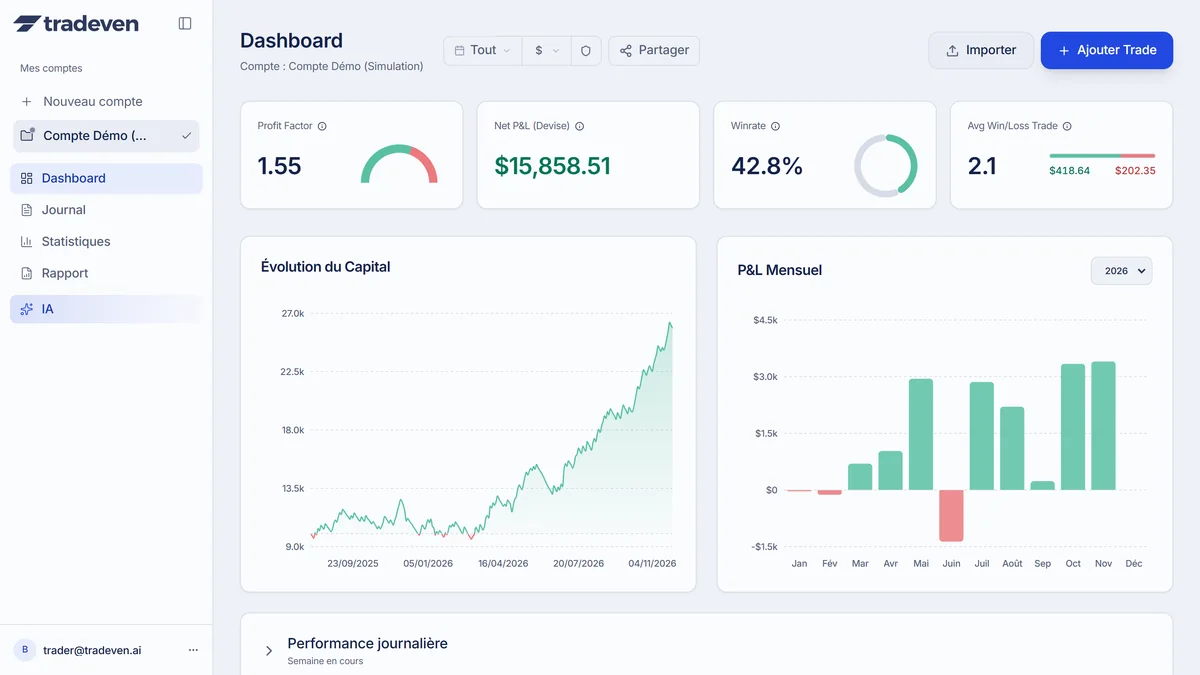
Tradeven does not read your emotions. In trades imported from MT4, MT5, cTrader or TradingView, it flags two of their consequences: streaks of at least three losses during which your size grew by more than 50% from one trade to the next, and days when your number of trades is far above your average. You can also mark for each trade, including imported ones, whether you followed your plan; the Psychology tab then compares your results with and without plan adherence. The gap between trades and the winner/loser duration ratio still need to be calculated in Excel with the method above.
Frequently asked questions
05How do you manage emotions in trading?
Start by measuring where they act in your history: how long you hold losers, your gap and size after a loss, your size after a winning streak. Then write an if-then rule for each situation that costs you, before the session. Place your stop and target at entry so the decision is not made under emotion.
Should you remove emotions to trade well?
No. Emotions are information, and the City traders studied by Fenton-O'Creevy and colleagues used them in their judgments. What costs money is letting them decide your size or your exit, or suppressing them in the moment instead of anticipating them.
What should you do right after a big loss in trading?
Stop trading for the session if you have hit your daily loss limit; otherwise step away from the screen for at least 15 minutes. Log the loss in your journal with one question: did the trade follow my plan? If yes, it is an expected cost of your strategy. If not, the mistake is the deviation, not the outcome.
Why do I cut my winners too early and let my losers run?
That is the disposition effect, documented among individual investors by Terrance Odean in 1998: people realize gains more readily than losses, to avoid the regret of giving back a gain or locking in a loss. It shows in your history when your losers stay open much longer than your winners.
Does meditation help you trade better?
The trader studies cited here do not test meditation. What they show is that the intensity of emotional reactions, and how you regulate them, matters. A routine that helps you reframe a loss before the session points in the right direction; it does not replace written risk rules.
Sources
07- Lo A. W., Repin D. V. and Steenbarger B. N., Fear and Greed in Financial Markets: A Clinical Study of Day-Traders, American Economic Review (2005)
- Fenton-O'Creevy M., Soane E., Nicholson N. and Willman P., Thinking, feeling and deciding: the influence of emotions on the decision making and performance of traders, Journal of Organizational Behavior (2011)
- Gross J. J., Antecedent- and response-focused emotion regulation: divergent consequences for experience, expression, and physiology, Journal of Personality and Social Psychology (1998)
- Odean T., Are Investors Reluctant to Realize Their Losses?, The Journal of Finance (1998)
- Coval J. and Shumway T., Do Behavioral Biases Affect Prices?, The Journal of Finance (2005)
- Gollwitzer P. M. and Sheeran P., Implementation intentions and goal achievement: a meta-analysis of effects and processes, Advances in Experimental Social Psychology (2006)
- MetaQuotes, MetaTrader 4 Help, Account History
Educational content. It does not constitute investment advice. Trading leveraged products carries a high risk of losing your capital.